Every crack.
Every corner.
DamIt™ Dam Sealer — a non-toxic polymer powder from Shalex Industries — spread across the water surface by drone. It sinks to the floor and settles into the cracks and holes the water is escaping through, and because it only seals what it lands over, even coverage is everything. So it's flown on a GPS plan, not thrown from a boat.
Sealant only seals
where it lands.
A leaking dam loses water through cracks and holes in its floor you'll never see from the bank. A powder sealant fixes that by sinking down and settling into them — but it can only seal a crack it actually lands over.
Send someone out in a boat to throw it by hand and you get a heavy stripe where the boat went, thin water in between, and the wind gets a vote on the rest. The middle and the far bank get the least. Every gap in coverage is a gap in the seal.
Measure. Plan.
Spread. Settle.
Four steps from a leaking floor to sealant sitting in the cracks — with the same dose over every square metre.
Measure the surface
We map the dam's water surface from the air and dose DamIt to the measured area at Shalex's rate — 1 L per 10 m² of surface, so a 15 L bucket covers about 150 m². Not a guess from the bank.
Plan the flight
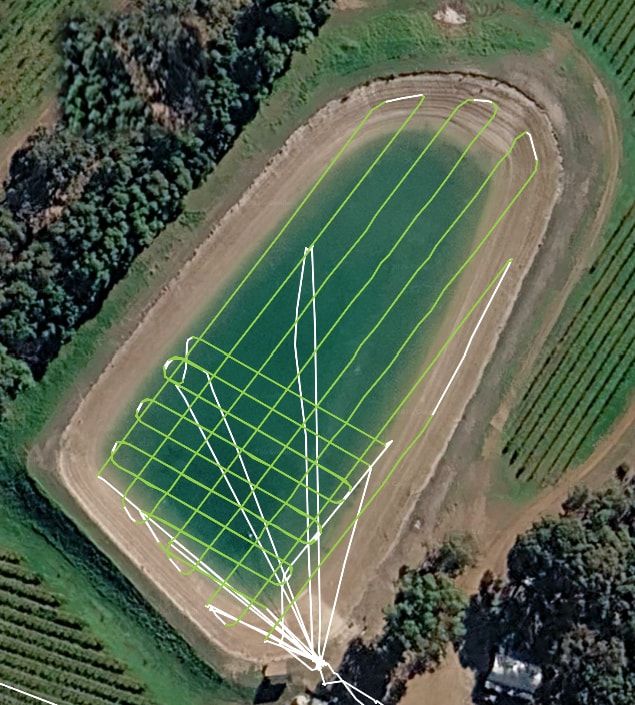
A GPS flight plan covers the full surface in even, parallel passes at a fixed spread width — no thin patches, no double-ups, no wandering lines.
Spread by drone
The powder goes out from the hopper at a metered rate across the whole surface — the middle and the far bank get exactly the same dose as the near one.
It settles into the cracks
DamIt sinks through the water to the dam floor — Shalex gives it a positive charge that draws it downward. Where water is escaping, the flow carries it into the cracks and holes; there it expands, binds to itself and packs in to close them off. It can only seal a crack it lands over — which is why coverage is everything.
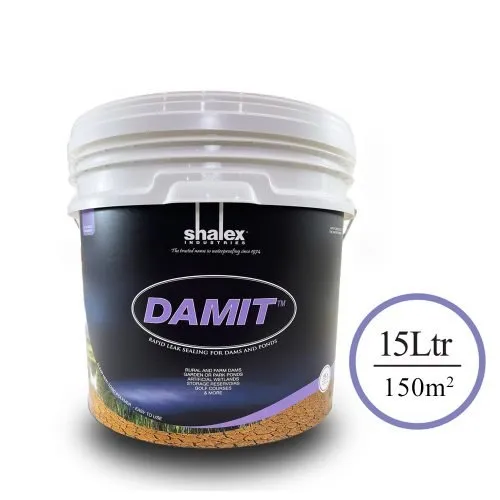
DamIt™ Dam Sealer.
By the bucket.
We use DamIt™ Dam Sealer from Shalex Industries — a non-toxic polymer powder made for rural and farm dams, irrigation channels, levee banks and storage reservoirs. It comes in 15-litre buckets, and we dose it by the measured surface of your dam.
Shalex's rate is 1 L per 10 m² of water surface, so one bucket does about 150 m². We work out how many your dam needs from the measured surface.
Shalex states it is approved for use with potable water and not toxic to humans, fish, aquatic plants or animals.
Rural and farm dams, ponds, irrigation channels, levee banks and storage reservoirs — clays through to sandy loams, fresh or saline water.
For expansive dams and lakes, Shalex points to a specialist drone service for efficient, even coverage. That's the service we run.
Same bucket of sealant.
Very different dam floor.
Both put the same product on the same dam. The difference is where it ends up — and whether anyone can tell you.
- Thrown by hand — heavy near the boat, thin in between
- A light powder goes wherever the wind sends it
- Lines drift on open water; the middle and far bank get least
- The dose is a guess, scoop by scoop
- No record of where any of it actually landed
- Parallel GPS passes at a fixed spread width — the same dose everywhere
- Metered from the hopper against the measured surface
- The middle and the far bank as easy as the near one
- Flown low and steady in the right conditions
- A coverage map of exactly where it went
Even coverage.
Every crack.
Sealant only seals where it lands. A GPS-flown drone puts it across the whole floor at a metered rate — which is why Shalex points to drone application for larger dams.
Even, edge-to-edge coverage
Sealant only seals what it lands over. Parallel GPS passes put a consistent dose across the whole floor — not a heavy stripe where the boat went and thin water everywhere else.
Into the cracks, not the bank
It sinks to the floor and is drawn by the escaping water into the cracks and holes it needs to fill. An even dose means the cracks you can't see from the bank get their share too.
The technique for larger dams
For expansive dams, Shalex points to a specialist drone service: the whole surface, evenly, in a fraction of the time of boat or hand spreading — and several dams in the same trip.
Metered dose
The hopper meters the rate against the measured surface, so the amount going out is known — not a scoop-by-scoop guess. You don't pay for buckets that weren't needed.
A coverage map, not a shrug
Every pass is logged. You get a map of exactly where the sealant went — proof the whole surface was treated, not a "yeah, we did most of it".
Non-toxic, stock & fish safe
Shalex states DamIt is approved for use with potable water and isn't toxic to humans, fish, aquatic plants or animals. Where fish are present we apply it in stages, as they advise.
Right dam, right result.
- Farm & rural dams
- Irrigation dams & channels
- Storage reservoirs & levee banks
- Earth dams — clay through to sandy loam
- Fresh or saline water
- Dams too big to cover evenly from a boat
- Lined dams (rubber or PE liners)
- Fibreglass, plastic, concrete or rock structures
- Moving water — streams, spillways, water features
- Heavily planted ornamental ponds
Dam sealing questions.
What product do you use?
DamIt™ Dam Sealer from Shalex Industries — a non-toxic polymer powder supplied in 15-litre buckets, each covering about 150 m² of water surface at the label rate of 1 L per 10 m². Shalex makes it for rural and farm dams, ponds, irrigation channels, levee banks and storage reservoirs.
How does dam sealing by drone work?
DamIt powder is spread across the water surface from the drone's hopper on a GPS flight plan. It sinks to the dam floor — Shalex gives it a positive charge that draws it down — and where water is escaping, the flow carries it into the cracks and holes, where it expands, binds and packs in to close them off. Because it can only seal a crack it lands over, the even coverage from parallel GPS passes is the whole point.
Why not just do it from a boat?
You can — but hand-throwing from a boat puts a heavy stripe where the boat went and thin coverage in between, the wind moves a light powder around, the lines drift on open water, and nobody knows what the middle or the far bank actually got. A drone flies parallel passes at a fixed width with a metered dose and logs where it landed. Shalex itself points to a specialist drone service for expansive dams.
Does the dam need water in it?
Yes — the sealant is spread onto the water and carried down to the floor and into the leaks by the water itself, so it's applied to a dam that's holding water. Tell us the current level and we'll advise on timing.
How long until the leak stops?
It depends on the dam — how big the leaks are, the soil, and how much sealant reaches them. Shalex quotes initial activation within 0–2 hours and full activation over 4–7 days, with water pressure continuing to draw DamIt into the leak paths over that time. We'll give you a straight answer on what to expect for your dam rather than a promise.
Is it safe for stock and fish?
Shalex states DamIt is approved for use with potable water and is not toxic to humans, fish, aquatic plants or animals. Where fish are present the manufacturer advises applying in stages, which is how we do it.
What dams does it work on?
Earth dams and ponds — farm and rural dams, irrigation dams and channels, levee banks and storage reservoirs — on clay through to sandy loam soils, fresh or saline water. DamIt isn't suitable for lined (rubber/PE), fibreglass, plastic, concrete or rock structures, moving water such as streams and spillways, or heavily planted ornamental ponds.
Where do you do dam sealing?
We're based in Margaret River and seal dams across WA's South West — Cowaramup, Witchcliffe, Karridale, Busselton, Nannup and surrounds. For a large dam, or several on one property, we'll travel further; just ask.
How much does dam sealing cost?
DamIt is dosed by surface area — 1 L per 10 m², so a 15 L bucket does about 150 m² — which means the size of the dam sets most of the cost, plus the flight. Send us the dam's approximate surface area, or drop a pin on a map, and we'll come back with a straightforward quote.
The whole dam.
Not just the near bank.
Tell us where the dam is and roughly how big — a pin on a map is enough. We'll dose it, fly it and send you the coverage map.